How to choose a hand dryer for the level of footfall in a building?
Publication date: 21 October 2026
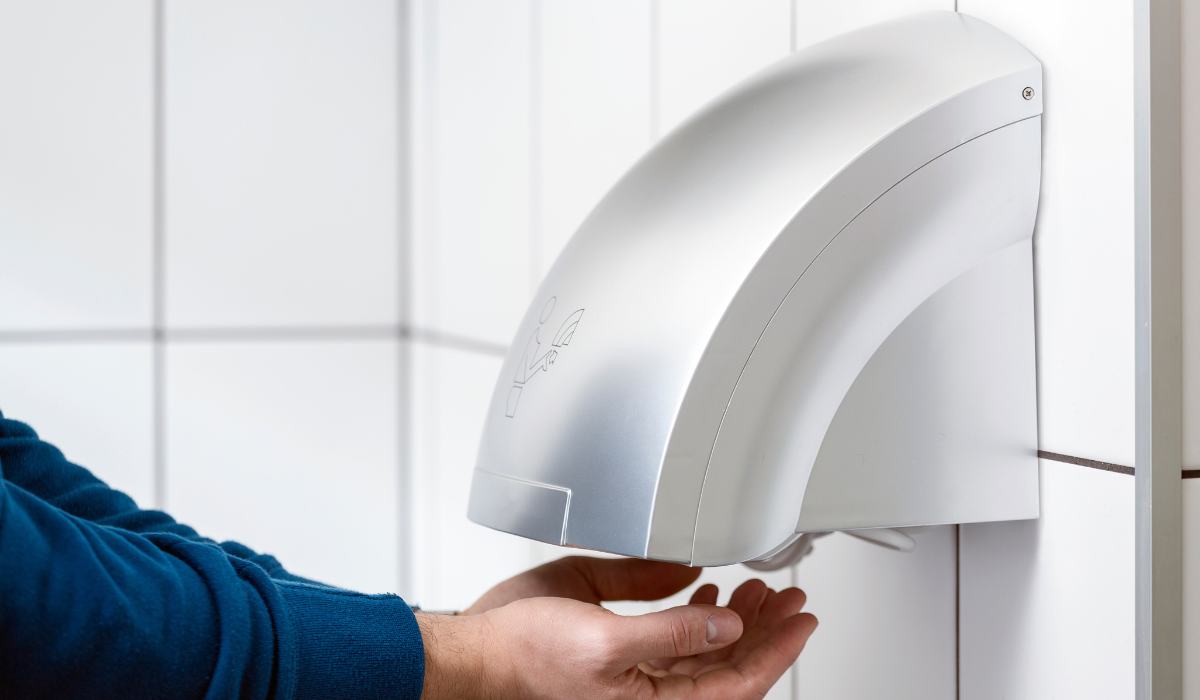
A hand dryer may work well in a small office yet create queues during a conference break. Suitability depends on more than power and the advertised drying time: it also depends on how many users arrive together. Here is how to estimate the required capacity and choose equipment for actual operating conditions.
Start with peak-time traffic
Knowing that a building has 500 users a day is not enough. Some will not visit this particular toilet, others will use it several times, and demand may be concentrated in short periods.
Ask instead: how many people will want to dry their hands in this toilet during its busiest five or ten minutes?
In an existing building, count users of the washbasin area during several representative peak periods. Anonymous counting is sufficient; there is no need to record people’s identities or personal data.
For a new building, develop scenarios based on its use: breaks and mealtimes in offices, school bells, cinema finishing times or intervals in an event programme.
Daily uses help assess the equipment’s operating workload. Short peaks help determine the number of drying stations. Both are needed.
What do low, medium and high traffic mean?
Commercial descriptions cannot replace a calculation for the actual room. Without a number of users and a time interval, “high traffic” is a relative term.
At low traffic levels, users rarely meet at the dryer. Price, ease of use, size and acoustic comfort may be the priorities.
At moderate traffic levels, two or three users regularly arrive together. A shorter drying cycle can reduce waiting, but also assess the room layout and whether a second station is feasible.
At high or sharply concentrated traffic levels, users arrive in groups. Provide enough stations, effective drying and equipment designed to perform repeated cycles under the intended conditions.
One fast dryer will not solve every problem. Several devices or a combination of dryers and paper towels may be needed.
Drying time is only part of service time
A product sheet may state a drying time of 10 seconds. A station remains occupied longer: the user approaches, positions their hands, sometimes restarts the dryer and then moves away.
For an initial estimate, use:
Station occupancy time = drying time + user changeover time.
If drying takes 12 seconds and changing users takes another 3 seconds, occupancy is 15 seconds per person. The theoretical capacity is four people per minute.
This does not mean the dryer can continuously serve four people per minute without a queue. Arrivals are uneven and some users need longer. Leave spare capacity.
How many dryers are needed? An example
Assume 60 people use this washbasin area during a ten-minute break. With 15 seconds of station occupancy per person, the total workload is:
60 people × 15 seconds = 900 seconds of station occupancy.
Ten minutes provides 600 seconds. A single dryer therefore cannot serve the whole group in that interval, even with perfectly smooth changeovers.
Two dryers provide 1,200 seconds in total, giving average utilisation of 75%. A queue can still form if most people arrive together.
For preliminary planning, this example assumes a maximum utilisation of 70%:
Number of stations = users × occupancy time ÷ peak period duration ÷ 0.70.
For the example:
60 × 15 ÷ 600 ÷ 0.70 = 2.14.
Rounding up gives three stations.
The 0.70 factor is an assumption for this analysis, not a standard or a guarantee against queues. With evenly distributed arrivals, two stations might suffice. With large simultaneous groups, even three may need supplementary paper towels. Compare the result with the room layout and actual peak patterns.
Which dryer specifications should you check?
Drying time and effectiveness
A short cycle helps only if users finish with dry hands. If they need two cycles, actual service time increases.
Use manufacturers’ declared times for preliminary comparison. Test methods, room temperature, hand position and the water remaining on the hands can affect results.
For a larger project, test the device in practice. Check whether use is intuitive and whether noise, temperature or an awkward position makes people stop drying early.
Permitted intensity of use
Drying time alone does not tell you how many consecutive cycles a dryer can perform in your facility.
Ask about the intended application, thermal protection, operating limitations and motor maintenance. Check warranty terms and service availability too.
An automatic timed cut-off may protect against an accidentally obstructed sensor. It is not a declaration of the permitted daily workload.
Electrical power and the cost of drying hands
Higher power does not automatically mean higher capacity or a greater cost per use. Operating time matters too.
Estimate energy per cycle using:
Energy in kWh = power in kW × operating time in seconds ÷ 3600.
A hypothetical 2.3-kW device operating for 20 seconds uses about 0.0128 kWh. A 1.35-kW device operating for 12 seconds uses about 0.0045 kWh.
At 100,000 such cycles, the totals are about 1,278 kWh and 450 kWh respectively. At an assumed PLN 1 per kWh, the difference is about PLN 828 annually.
This is a simplified comparison of scenarios, not measured results for particular models. It assumes constant stated power and excludes standby, repeat cycles and maintenance. It shows why operating cost cannot be judged from watts alone.
Noise level
Noise may determine the choice near classrooms, consulting rooms, hotel rooms or workstations.
Compare values measured under equivalent conditions. A decibel figure at two metres is not directly comparable with one measured at another distance. Room reverberation, doors and mounting also matter.
Several dryers operating together increase the acoustic load. Where young children or sound-sensitive users visit, provide paper towels as an alternative.
Example Faneco dryers and their applications
PONENTE
| Housing material | ABS plastic |
|---|---|
| Activation type | sensor |
| Power (W) | 2300 W |
| Min. drying time (s) | 15 s |
| Max. drying time (s) | 20 s |
| Noise level (dB) | 70 dB |
When planning, allow for longer station occupancy than with models claiming around 10 seconds. This may matter little in a quiet room but increase the number of stations needed during a short break.
PASSAT H
| Housing material | Brushed AISI 304 stainless steel |
|---|---|
| Power (W) | 1350 W |
| Min. drying time (s) | 10 s |
| Max. drying time (s) | 15 s |
| Additional features | possibility of turning on the cold air supply |
This is an option to assess where a short cycle and steel housing are priorities. Turning off heating can change comfort and actual drying time, so test the setting that will be used.
MONSUN
| Housing material | ABS plastic |
|---|---|
| Power (W) | 1900 W |
| Min. drying time (s) | 7 s |
| Max. drying time (s) | 10 s |
| Noise level (dB) | 73 dB |
| Height (mm) | 687 mm |
| Width (mm) | 300 mm |
| Depth (mm) | 220 mm |
A short declared cycle can help with frequent user changes. Allow space in front of the device and check whether placing hands inside it is convenient for the people using the toilet.
Select by the complete product code. A series name does not replace the current technical sheet, instructions and availability confirmation.
Hands-under or hands-in dryer?
Hands-under dryers let users dry their hands beneath the device without inserting them into a chamber. Mounting height, sensor access and standing space affect convenience.
Hands-in dryers use a defined drying space. This can help guide hand movement through the airflow, but accessibility needs checking for different users.
With either design, consider where water goes. If there is a reservoir or drainage component, allow for cleaning it. If water can reach the floor, location and cleaning frequency become important.
A hands-in design does not automatically make a device better for every building. Assess the actual specifications, ergonomics and maintenance.
Layout can matter as much as device numbers
Two dryers mounted too close together may function as only one station if users cannot comfortably stand side by side.
Waiting users should not block doorways or access to cubicles. Plan the route from washing to drying to limit dripping across the room.
For an accessible toilet, check approach space and sensor reach. One mounting height cannot meet every child’s, shorter adult’s and wheelchair user’s needs. Follow the particular model’s instructions and the accessibility design.
A qualified electrician should assess supply, protection and simultaneous operation of all devices. Check the IP rating against the installation location. A dryer for an ordinary toilet is not automatically suitable for every wet area.
Hygiene: a dryer does not replace cleaning
CDC guidance allows either a clean towel or an air dryer for drying hands and emphasises thorough drying. Evidence is insufficient to declare one method universally better for reducing germs on hands. The appropriate method also depends on the facility’s procedures.
Do not base the purchase on a generic claim to be “the most hygienic dryer”. Check how the housing, inlets, sensors and any water reservoir are cleaned.
If there is a filter, establish its type, availability and maintenance schedule. A HEPA label does not mean hands are disinfected or that the equipment no longer needs regular cleaning.
In healthcare and other areas with special hygiene requirements, agree the drying method with those responsible for the facility’s hygiene procedures.
How can you keep the toilet usable if a dryer fails?
For heavy usage, plan a fallback: another independent station or a paper towel dispenser with a maintained supply.
Ask about spare parts, fault reporting and service scope before purchasing. A warranty including transport of the device does not necessarily provide a temporary replacement during repair.
After opening, observe a real peak. Look for queues, repeated cycles, wet flooring and people leaving without drying. These observations assess the whole arrangement, not just the device specification.
The first queue will test the choice
The real test comes during a conference break, after a film or between lessons. Check whether successive users can dry their hands comfortably, waiting people block routes and noise disturbs neighbouring rooms.
Repeat these observations after opening. Wet hands may result from long waits, an awkward location or unclear operation. Replacing the dryer is not always necessary; an extra station or a better layout may make the greater difference.
A well-planned drying area should make it obvious where to stand and how to use the equipment, without making users wonder whether it is worth waiting. It lets them finish washing and return to their activities.