What should you look for when buying a paper towel dispenser?
Publication date: 21 November 2024
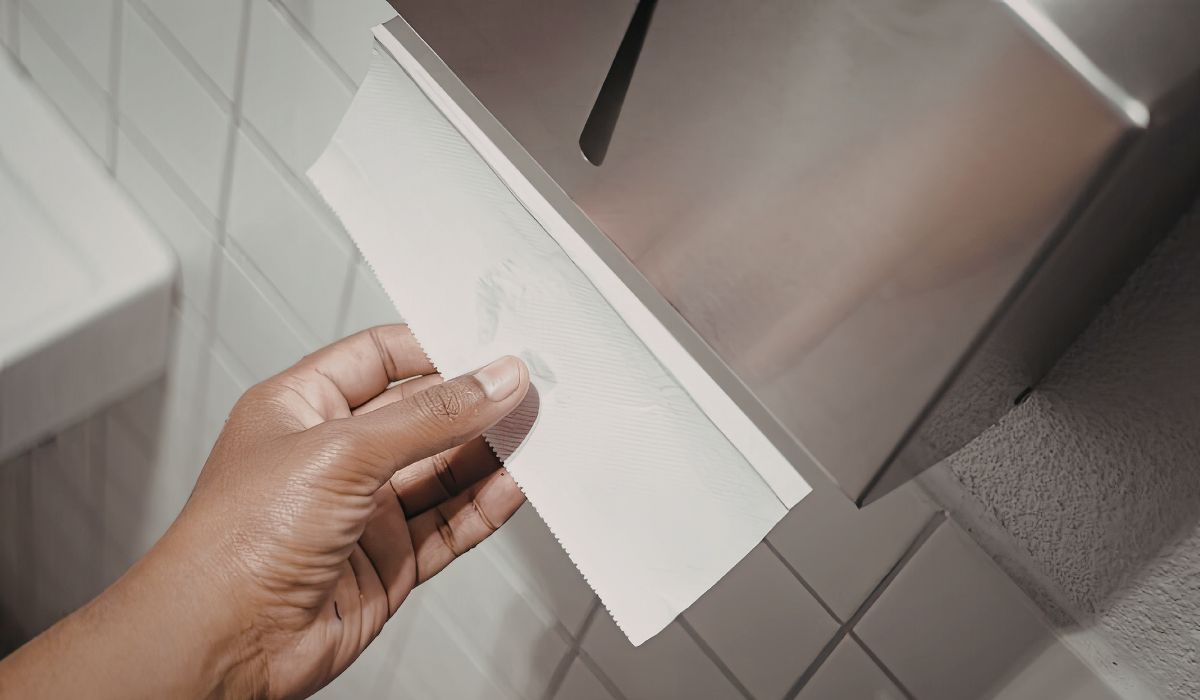
A paper towel dispenser seems like a simple product—until it starts causing problems. Paper towels that get stuck, insufficient capacity, the wrong roll size, an overflowing wastebasket, and a wet floor by the sink quickly make it clear that your choice shouldn’t be left to chance. A good paper towel dispenser isn’t just about looking good. It’s designed to function reliably every day, reduce paper waste, make cleanup easier, and improve restroom hygiene.
Why does the choice of feeder matter?
In a public restroom, users judge how convenient it is very quickly. They wash their hands, want to dry them, and leave. If the paper towels don’t feed out smoothly, if you have to pull out several at once, or if the paper towel dispenser is empty, the overall impression of the restroom immediately suffers. Even a well-finished restroom begins to look poorly managed.
A paper towel dispenser is one of the most frequently used items in a restroom. In an office, school, restaurant, hotel, shopping mall, gas station, clinic, workplace, or sports facility, it can be used dozens, hundreds, or even thousands of times a day. This means it must be chosen based on actual usage, not just the bathroom’s appearance.
At Faneco, we often emphasize that public restroom equipment must be evaluated from a long-term perspective. The cheapest towel dispenser may seem like a good buy, but if it requires frequent refills, jams the paper, wears out quickly, or isn’t compatible with popular refills, costs and problems will arise later on.
A good paper towel dispenser should meet four criteria: it should be user-friendly, easy for staff to operate, able to withstand heavy use, and compatible with the paper towels that will be used at the facility.
First, determine where the feeder will be used
The first question isn’t “Which dispenser is best?”, but “Where will it be installed?”. A small restroom in an office requires a different solution than a restaurant, a school, a manufacturing plant, or a restroom at a gas station.
In a small office, aesthetics, ease of refilling, and moderate capacity are what matter most. In a restaurant, it’s important to make a good impression on guests, ensure hygiene, and maintain consistency with the decor. In a school, durability, easy dispensing, and protection against excessive wear and tear will be key. In a workplace, a paper towel dispenser must withstand frequent use and contact with dirtier hands. In a restroom at a gas station or shopping mall, capacity, durability, and quick service are of the utmost importance.
It’s also important to distinguish between restrooms for customers and restrooms for employees. In public restrooms, resistance to vandalism, lockable doors, and minimizing paper waste are more important. In employee restrooms, a simpler paper towel dispenser can sometimes be used, but it’s still important to ensure sufficient capacity and reliability.
If a facility has several restrooms, it’s a good idea to use a single, consistent dispenser system. This makes it easier to purchase refills, simplifies staff work, and facilitates inventory control.
Types of paper towels. The most important purchasing decision
You always need to choose a paper towel dispenser that matches the type of refill. This is one of the most common causes of problems. A customer buys a paper towel dispenser, only to find later that the paper towels in stock don’t fit, get jammed, or come out several at a time.
The most popular are dispensers for folded towels and paper towel dispensers on a roll. Folded towels come in various folding styles, including ZZ, V, C, and other formats depending on the manufacturer. They may look similar on the outside, but not every towel will work the same way in every dispenser.
Folded towels are convenient and easy to use. The user pulls out a single sheet, and the next one slides out automatically or is easily accessible. Proper dispensing reduces waste because the user doesn’t have to pull out a whole handful of paper.
Roll towels are particularly well-suited for high-traffic areas where a larger roll capacity is important. They can be used in central dispensing systems or in dispensers that automatically cut off a single sheet of paper. Such solutions can be very efficient, but they require matching a specific type of roll to a given model.
Before making a purchase, you should therefore check not only the product name, but also its compatibility with the towel size, width, length, folding method, and the dispenser’s maximum capacity.
Folded Towel Dispensers
Folded towel dispensers are popular because they are simple, convenient, and familiar to users. They work well in offices, restaurants, medical offices, hotels, schools, service establishments, and many public restrooms.
Their advantage is their intuitive operation. The user doesn’t have to press a button or wait for the towel to dry. They simply pull out a towel, dry their hands, and throw it in the trash. With the right towel and dispenser, it’s easy to control consumption.
The most important thing, however, is to match the formats. Towels folded in a ZZ or V shape can be dispensed one at a time if the dispenser is designed for them. C-fold towels tend to be less precise in dispensing if they aren’t properly selected. Towels that are too small may fall out, while those that are too large may get jammed.
When making a purchase, it’s a good idea to check the width and depth of the compartment, how the paper towel is dispensed, the maximum number of sheets, the level-check window, and how easy it is to refill. In a high-traffic restroom, the viewing window is very practical because staff can see if the paper towel dispenser needs to be refilled without opening the housing.
Dispensers for paper towels on a roll
Paper towel dispensers for roll towels are a good choice where greater capacity and less frequent restocking are important. They work well in high-traffic restrooms, industrial facilities, shopping centers, gas stations, sports arenas, and other places where paper towels are used up very quickly.
Their biggest advantage is efficiency. A single roll can last longer than a standard pack of folded towels. In many systems, the user receives a specific amount of paper, which helps reduce excessive waste.
However, it’s important to pay attention to the type of system. Some paper towel dispensers require a specific type of roll, with a specific diameter, width, and core. If a facility purchases paper towels from various sources, care must be taken not to choose a system that is too proprietary, as this will make future purchases more difficult.
It’s also worth checking how the roll is replaced. In large facilities, staff must refill the feeders quickly. If replacing the roll is inconvenient, time-consuming, or requires complicated paper handling, maintenance will become problematic.
Feeder Capacity
Capacity is one of the most important factors—and yet one of the most frequently overlooked. A paper towel dispenser that’s too small may look good in a small restroom, but if you have to refill it several times a day, it’s not practical.
In a restroom with low foot traffic, such as a small office, a compact dispenser for folded towels is sufficient. In a public restroom at a restaurant, school, or clinic, it’s better to choose a model with a larger capacity. In a high-traffic facility, it’s worth considering roll towels or a large dispenser for folded towels.
A large capacity helps avoid three problems: running out of paper, the need for frequent maintenance, and user frustration. Running out of paper towels after washing your hands is particularly annoying because your hands are wet and you often have no alternative.
It’s also important to consider the ratio between the dispenser and the wastebasket. The more paper towels used in a given restroom, the larger the wastebasket should be—or the more frequently it should be emptied. A large paper towel dispenser alone won’t solve the problem if the wastebasket overflows after just an hour.
Housing material. ABS or stainless steel?
Paper towel dispensers are most often made of ABS plastic or stainless steel. Both options make sense, but under different conditions.
ABS plastic is lightweight, aesthetically pleasing, and works well in many offices, commercial spaces, schools, clinics, and restrooms with moderate traffic. It is easy to keep clean and is usually affordable. High-quality ABS should not be confused with cheap, brittle plastic. In professional products, it can be a very practical choice.
Stainless steel is ideal for places where fixtures need to be more durable. This includes gas stations, train stations, shopping malls, public restrooms, sports facilities, industrial plants, and areas prone to heavy use or vandalism. Stainless steel is durable, easy to clean, and looks great in modern interiors.
The choice of material should depend on foot traffic, the risk of damage, the facility’s standard, and the restroom’s style. For a small office, it’s not always necessary to buy the heaviest steel model. However, for a high-traffic public restroom, a paper towel dispenser made of plastic that’s too flimsy may quickly prove to be a mistake.
Lock and protection against uncontrolled wear
In public restrooms, the dispenser should be lockable with a key. This provides basic protection against the removal of entire packs of towels, accidental opening, messes, and theft of refills. In high-traffic facilities, a lock is not just an accessory—it is an essential part of operational management.
It’s worth checking whether the lock operates smoothly, whether the key works for multiple containers from the same series, and whether the housing remains stable when locked. If multiple models with different keys are used throughout the facility, staff end up wasting time.
Proper dispensing also helps reduce waste. A paper towel dispenser should allow users to pull out a towel in a controlled manner. If the paper comes out in handfuls, the wastebasket fills up faster and operating costs rise. If the towel is too difficult to pull out, the user will start tugging at it and damaging the roll.
The best towel holder is one that naturally encourages you to take just one or two towels, rather than the whole stack.
Ease of refilling
For users, convenience is what matters. For staff, service is what matters. A paper towel dispenser should open easily, allow for quick refilling, and not require complicated paper loading.
It’s worth paying attention to the width of the opening, the stability of the lid, access to the interior, the absence of sharp edges, and the clear arrangement of the towels. If staff have to readjust the paper several times after closing the dispenser, the product will be cumbersome.
The feed level indicator window is very practical. It allows you to quickly check whether the feeder needs to be refilled. In high-traffic facilities, it saves time and reduces the risk of shortages.
For larger facilities, it’s a good idea to choose systems that are consistent with other fixtures. If soap dispensers, toilet paper holders, and paper towel dispensers all open in a similar way, maintenance is easier.
Installation and placement near the sink
Even the best paper towel dispenser will be inconvenient if it’s installed incorrectly. Its location should follow the user’s natural path: first the sink, then the soap, then drying your hands, and finally the trash can.
The towel dispenser should be located near the sink, but not in a spot that is constantly exposed to splashes. If it is too far away, users will walk across the room with wet hands, causing water to drip onto the floor. This compromises cleanliness and may increase the risk of slipping.
The trash can should be placed right next to the dispenser. If the trash can is on the other side of the restroom, some users will leave their paper towels on the sink or toss them somewhere random. In a small restroom, these elements must be planned together, because a paper towel dispenser without a proper trash can creates a problem.
In a restroom accessible to people with disabilities, the dispenser should be installed within reach of a seated person and must not require difficult maneuvering. Accessibility applies to accessories as well, not just the toilet and sink.
Hand Hygiene and Drying
Drying your hands is an important part of personal hygiene. Wet hands spread germs more easily than thoroughly dried hands, so simply having a sink and soap is not enough. Users should be able to dry their hands comfortably, quickly, and effectively.
Paper towels have the advantage of being intuitive, quick, and disposable. Many users perceive them as hygienic, especially in public places. Additionally, paper towels allow you to dry your hands immediately, which is important in high-traffic restrooms.
This does not mean that hand dryers have no use. They are practical in many facilities, especially where the goal is to reduce waste. The choice between paper towels and a hand dryer should depend on the type of facility, costs, maintenance, user expectations, and the ability to maintain cleanliness.
In practice, paper towels often come out on top when speed, simplicity, and predictability are key. However, this requires a well-chosen paper towel dispenser and a wastebasket with sufficient capacity.
Trash can. An integral part of the system
When buying a paper towel dispenser, you need to plan for a wastebasket right away. It’s part of the same system. If the dispenser has a large capacity but the wastebasket is too small, the restroom will quickly look neglected.
The trash can should be placed near the waste receptacle, have adequate capacity, and be easy to empty. In higher-end restrooms, lidded trash cans or those that conceal the waste work well. In high-traffic areas, capacity and quick service may be more important.
In small restrooms, the trash can must not block the aisle or the space needed to maneuver. In restrooms accessible to people with disabilities, special care must be taken to ensure that the trash can is not placed in a spot where a wheelchair needs to turn.
Not having a properly chosen trash can is one of the most common causes of clutter around sinks. Paper towels are only convenient if the user has a place to throw them away.
Operating costs—in other words, the price of the feeder—aren’t the whole story
When buying a dispenser, it’s easy to focus on the price of the unit itself. That’s a mistake. In the long run, the cost of towels, the frequency of restocking, paper consumption, the amount of waste, and staff time may be more important.
An inexpensive paper towel dispenser that dispenses several towels at a time increases paper consumption. A model with too small a capacity requires more frequent servicing. A dispenser that isn’t compatible with popular refills may limit your choice of suppliers. A product with a flimsy housing may need to be replaced quickly.
That’s why it’s important to consider the total cost of ownership. A higher-quality dispenser may cost more upfront, but it can be more economical in day-to-day use. Especially in high-traffic facilities, the difference in towel usage can be very noticeable.
It’s also worth checking the availability of refills. If towels compatible with a given system are hard to find or expensive, the facility may have trouble restocking them regularly.
Aesthetics and consistency with the rest of the furnishings
A paper towel dispenser is a prominent feature in a restroom. It should complement the soap dispenser, toilet paper holder, trash can, hand dryer, toilet brush, and the overall style of the room. Coordinated fixtures make the restroom look more professional.
In modern facilities, stainless steel dispensers, black accessories, white plastic lines, or sets designed in a single style work well. In offices and commercial spaces, aesthetics can be just as important as functionality, because the restroom is part of a company’s image.
It’s worth remembering, however, that appearance shouldn’t take precedence over practicality. A very small, designer paper towel dispenser might not work well in a high-traffic restroom. A glossy surface may require more frequent polishing. A dark color may blend in better with the interior, but you’ll need to check whether water stains and fingerprints are visible on it.
The best choice is one that combines style, durability, and ease of maintenance.
Paper Dispenser in the Small Restroom
In a small bathroom, every centimeter counts. The dispenser shouldn’t protrude too far, block the passageway, or interfere with the mirror, trash can, door, or sink. In such spaces, compact dimensions and thoughtful installation are especially important.
The smallest model isn’t always the best choice. If a restroom gets a lot of traffic, a paper towel dispenser that’s too small will constantly be empty. So it’s a good idea to find a balance between size and capacity.
In a small restroom, the placement of the trash can is very important. If there isn’t enough space for a large freestanding trash can, you might consider a narrower model that is mounted on the wall or placed directly under the paper dispenser. It’s important that the user be able to throw away a towel without having to make any extra movements.
A well-designed small restroom should guide the user intuitively. Washing hands, drying them, and disposing of the towel should all take place within a single, logical zone.
A dispenser in a high-traffic public restroom
In high-traffic restrooms, capacity, durability, and speed of service are the most important factors. This applies to shopping malls, gas stations, train stations, schools, stadiums, manufacturing facilities, and event venues.
In such locations, it’s best to choose feeders that are lockable, durable, have a larger capacity, feature a viewing window, and have an easy-to-use refill system. If the risk of damage is high, stainless steel works well. If cost-effectiveness is a priority and the risk of vandalism is moderate, high-quality ABS is worth considering.
Standardization is particularly important in large facilities. Using the same models of paper towel dispensers in multiple restrooms simplifies storage, inventory control, and maintenance. Staff do not have to remember which dispenser requires which type of paper towels or which key.
A high-traffic restroom doesn’t forgive mistakes. A dispenser that’s too small, the wrong kind of towel, or an inconvenient restocking system quickly become a daily problem.
The Most Common Mistakes When Buying a Feeder
The first mistake is buying a dispenser without checking the type of towels. That’s the surest way to cause jams, have the rolls fall out, or end up having to buy more expensive supplies.
The second flaw is that the capacity is too small. The container looks nice, but it needs to be refilled constantly. The third flaw is the lack of a viewing window in high-traffic areas. Staff have to open the feeder to check the paper level.
The fourth mistake is installing it too far from the sink. Water drips onto the floor, and the toilet gets dirty faster. The fifth mistake is not having a trash can nearby. Users leave towels on the counter, on the floor, or next to the sink.
The sixth mistake is choosing a material that is too delicate for a public restroom. The seventh mistake is basing the decision solely on the purchase price, without analyzing the cost of refills and wear and tear. The eighth mistake is a lack of consistency with the rest of the fixtures.
The ninth mistake is failing to consider accessibility. A paper towel dispenser installed too high or in an inconvenient location can be a problem for children, seniors, and people with disabilities.
A Practical Pre-Purchase Checklist
Before making a purchase, it’s a good idea to answer a few questions. How many people use the restroom each day? Is the traffic steady, or does it come in waves? Is the restroom public, for employees, in a hotel, at a school, in a restaurant, in an office, or in an industrial setting? What type of towels do you want to use? Should they be folded or in rolls? Are the refills easily accessible?
You also need to check how much space there is next to the sink, where the trash can will go, whether the dispenser will be constantly exposed to splashes, whether the user can comfortably reach for a towel, and whether staff will be able to easily refill the dispenser.
It’s worth paying attention to the material, capacity, closure mechanism, viewing window, towel compatibility, design, warranty, availability of replacement parts, and compatibility with other accessories.
If the paper towel dispenser is intended for a high-traffic restroom, it’s best to choose a more durable and spacious model right from the start. If it’s for a small office restroom, you can opt for a compact, attractive product, but you should still check the refill size and ease of maintenance.
How can Faneco help you make a choice?
Faneco offers paper towel dispensers designed for various types of restrooms: office, hotel, school, food service, industrial, and public. The product line includes models made of ABS plastic and stainless steel, dispensers for folded towels, and containers in various sizes and designs.
When making your selection, it’s a good idea to consider the entire set of fixtures. The towel dispenser should match the soap dispenser, trash can, toilet paper holder, toilet brush, and the overall style of the restroom. This ensures the room has a cohesive look and makes the staff’s job easier.
A good dispenser is one that doesn’t cause any problems. The user simply pulls out a towel, dries their hands, and leaves. Staff quickly restock the dispenser. The facility owner doesn’t have to deal with constant complaints, mess, or excessive paper waste.
Summary
When buying a paper towel dispenser, you should consider more than just the price and appearance. The most important factors are: the type of towels, capacity, material, durability, dispensing method, lock, ease of refilling, installation location, accessibility for users, and the fit of the waste bin.
In a small restroom, compact size and logical placement next to the sink are key. In a high-traffic public restroom, capacity, durability, and quick service are more important. In a hotel or restaurant, aesthetics and consistency with the decor are also factors. In a school, gas station, or train station, durability and wear control are particularly important.
The best paper towel dispenser is one that suits a specific facility. There is no single model that’s perfect for everyone. Instead, there is a well-chosen solution that improves hygiene, reduces clutter, makes staff’s work easier, and makes the restroom more comfortable for users.