At what height should a countertop sink faucet be installed?
Publication date: 23 April 2026
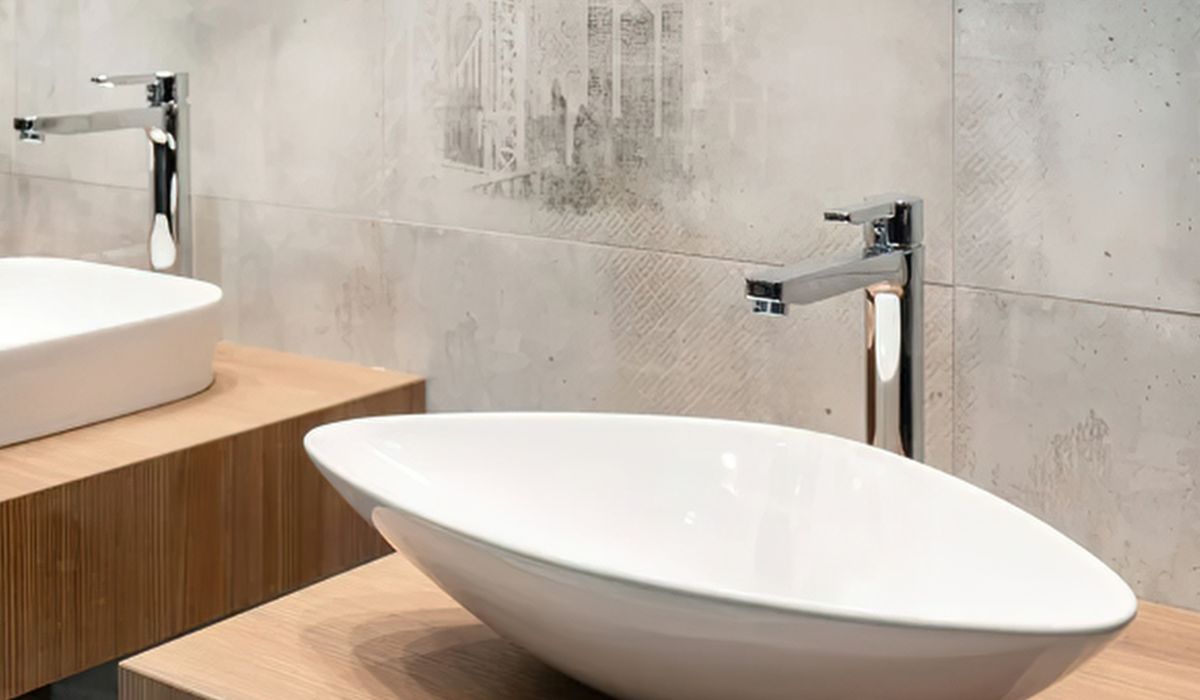
Countertop sinks are one of the most popular choices for modern bathrooms. They look good in renderings and in showrooms, but in practice, they’re very often a source of problems. Not because they’re bad, but because they’re poorly designed. The most common mistake involves the height of the faucet and how well it fits the basin.
This is one of those details that seems insignificant during the design phase but later affects your day-to-day comfort. In this article, we’ll show you how to approach this issue in a practical way and why a few centimeters really do make a difference.
Where to Start: A Point of Reference
The first mistake, which occurs very often, is thinking about the height of the faucet relative to the floor. In the case of countertop sinks, this approach doesn’t work.
The key reference point is the top edge of the sink—more specifically, the relationship between it and the tip of the faucet spout. It is this distance that determines whether the sink will be comfortable to use and whether the water will end up where it’s supposed to.
For the sake of clarity, however, it’s worth knowing the general context. According to European guidelines, the standard height of the top edge of a sink is approximately 85–90 cm from the floor. In the case of countertop sinks, this means that the countertop itself must be lower—usually around 75–80 cm—since the height of the basin is included in the total height.
The optimal height of the faucet and where the 12–15 cm range comes from
In practice, it is generally accepted that the tip of the spout should be about 12–15 cm above the top edge of the sink. This is not a random number or a marketing standard.
This range is based on observations of how users interact with the sink. At this distance, hands have enough room to move freely under the water stream. At the same time, the stream does not have time to spread out too much, which reduces splashing.
If the faucet is installed too low, comfort issues quickly arise. It’s harder to wash your hands, harder to rinse your face, and larger dishes practically won’t fit under the spout. On the other hand, a faucet that’s too high causes the water to fall with greater force and splash to the sides, often beyond the edge of the sink.
When measured from the floor, this usually results in a range of about 95–105 cm, but it’s worth noting that this is just the final figure. What matters most is the relationship to the sink, not the number itself.
Height is one thing, but the spout’s reach is just as important
This is a factor that, in practice, can be even more important than the height itself. You may have a faucet that’s perfectly sized in terms of height, but if the spout is too short or too long, the result will be far from what you expected.
The stream of water should hit roughly near the drain or slightly in front of it. This allows the water to flow naturally toward the center and prevents it from splashing off the sides of the bowl.
If the spout is too short, the water flows close to the edge and splashes onto the countertop very easily. This is one of the most common problems in bathrooms with countertop sinks. On the other hand, a spout that’s too long forces you to position your hands unnaturally, which reduces comfort.
In practice, a good rule of thumb is that the spout should extend from one-third to one-half the width of the sink.
Different Types of Faucets and Their Impact on Installation
The choice of faucet type directly affects how its height is determined.
Deck-mounted faucets installed directly on the sink have limited applicability with countertop models. They work best with basins with a lower overall height, where the difference in height is not significant.
Countertop faucets—that is, those mounted next to the sink—are the most popular choice. They offer a great deal of design flexibility, but require careful consideration of height, as there is no single standard reference point.
Wall-mounted faucets offer the greatest control over placement, since their height can be precisely planned during installation. In this case, a similar rule applies as before—approximately 12–15 cm above the edge of the sink—but with even greater emphasis on the precise alignment of the water stream.
The type of sink matters more than you might think
Not every countertop sink behaves the same way when it comes into contact with water. The differences stem from the depth, shape, and diameter of the basin.
Shallow sinks require taller faucets because the workspace is limited. With these models, a faucet that’s too low quickly becomes a nuisance. At the same time, you have to watch out for splashing, which happens more easily in shallow basins.
Deep sinks are more “forgiving.” They allow for the use of lower-profile faucets and provide better control over the water flow, as the sides of the basin limit splashing.
Shape matters, too. Round and oval sinks distribute water more evenly, while rectangular models with flat bottoms are more likely to cause the water stream to bounce off the surface.
Why do a few centimeters make such a big difference?
In theory, a difference of 2–3 cm seems small. In practice, it’s often the difference between comfort and annoyance.
If the faucet is too low, every hand movement is restricted. The user starts to bump into the spout, and using the sink is no longer intuitive. When the faucet is set too high, controlling the water becomes a problem. The stream hits with greater force, bounces off, and splashes.
These aren’t issues that are immediately apparent during installation. They tend to surface during everyday use, often after the entire project has been completed.
The most common mistakes we see in practice
Most often, the problem starts when a customer chooses a faucet based solely on its appearance. The customer sees a model on display and assumes it will fit any sink.
The second mistake is failing to calculate the total height of the entire set. The countertop, sink, and faucet are selected separately, without checking how they will work together.
The third mistake is ignoring the manufacturer’s technical specifications. Each faucet has a specific spout reach and stream height, which should be matched to a specific sink.
The fourth mistake is installing the faucet without first trying to position it. In practice, it’s often enough to position the faucet “dry” and check its placement relative to the sink to avoid problems.
Lessons Learned from the Design Process
The most important conclusion is simple. The faucet is not just an accessory to the sink. It is an integral part of the entire system.
You’ll get the best results by starting your design with the sink. First, choose a sink model; then select a faucet that matches it in terms of height and reach; and only then determine its exact location.
Experience also shows that it’s better to spend more time on this stage than to make corrections to the finished bathroom later. Adjusting the height of the faucets after installation is difficult and costly.
Summary from a Practitioner’s Perspective
The optimal height for a countertop sink faucet depends on the relationship between the various components, rather than on a single universal number.
The safest starting point is to position the tip of the spout about 12–15 cm above the edge of the sink and direct the stream toward the drain. This approach works well in most cases and offers a good balance between convenience and control over the water flow.
However, it’s important to treat each project on a case-by-case basis. Differences in sinks, the height of the users, and the layout of the bathroom have a real impact on the final result.
Sources and documentation
The documents cover the areas indicated in the link descriptions. Connection dimensions, fixings and installation parameters must be checked in the instructions for the specific device.
Faneco — catalogs and documentation for selecting a specific model