Do touchless toilets actually reduce maintenance costs?
Publication date: 5 March 2026
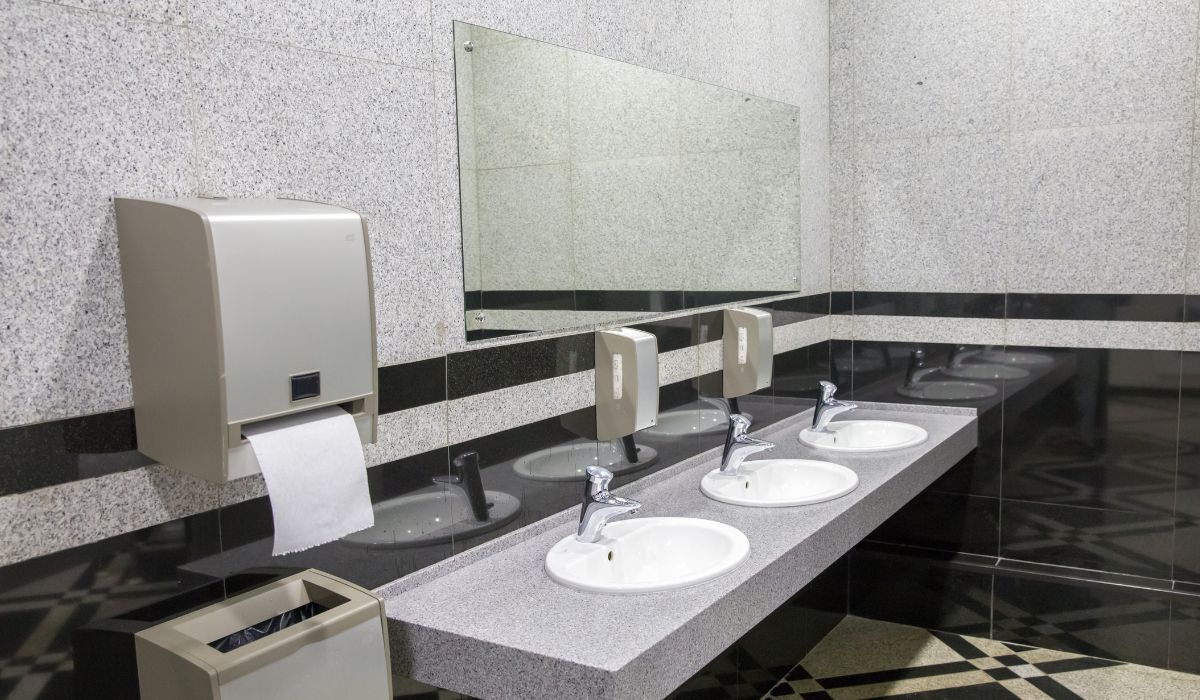
Touchless toilets are often seen as a “more expensive option.” Higher purchase price, electronics, maintenance. At first glance, it’s hard to believe that they can actually reduce costs.
The problem is that most people only look at the price of the device, not the total cost of ownership. And that’s where the biggest difference lies.
Where do bathroom costs come from in the first place?
When it comes to maintaining a public or office restroom, three factors are of the utmost importance: water consumption, cleaning supply usage, and cleaning costs.
It is precisely in these areas that contactless technologies make the biggest difference.
It’s worth noting that the bathroom alone accounts for over 30% of a building’s water consumption. And the toilet is one of the main sources of that consumption.
Water consumption – this is where the biggest savings are
The most concrete data pertain specifically to water.
Studies show that the use of touchless fixtures, particularly faucets and automatic systems, can reduce water consumption by as much as about 50%.
Why?
Because the user has no control over the flow time. With a traditional faucet, water often runs longer than necessary. With a touchless system, water flows only when it is needed.
A similar principle applies to automatic flushes. The system activates exactly when it should. No mistakes, no “double flushing.”
By comparison, older flushing systems use as much as 9 liters of water per flush, while modern systems use as little as about 3 liters.
If you multiply that by the hundreds of times it’s used each day in a public facility, the differences are enormous.
Exactly how much can you save?
In practice, it works like this:
If a touchless faucet reduces water consumption by about 50%, and 30% of total water consumption occurs in the bathroom, then:
• Total water consumption in a building can drop by as much as several percent
• On an annual basis, this translates to real savings amounting to thousands of zlotys in larger facilities
In addition, simply replacing your fixtures can lead to tangible savings. Replacing traditional fixtures with modern ones—including touchless models—can result in savings of up to about 600 zł per year per water outlet.
In facilities with many restrooms, the scale becomes very apparent.
Reduced use of cleaning products
This is an aspect that is often overlooked.
Touchless toilets minimize user contact with surfaces. Less touching means less dirt and fewer bacteria.
In practice, this means:
• Less frequent cleaning
• Lower chemical usage
• Lower water consumption during cleaning
Modern plumbing systems are designed to minimize the buildup of dirt and limescale. This directly affects operating costs.
Cleaning costs—the biggest “hidden cost”
In many facilities, the biggest expense isn’t water, but labor.
If the restroom needs to be cleaned every hour instead of every two hours, the costs add up very quickly.
Contactless solutions reduce:
• marks on faucets and buttons
• dirt around sinks
• water splashes
The result is simple. The toilet stays clean longer, so you can clean it less often.
Are there any downsides?
Yes, and it’s worth showing them as they really are.
The biggest drawback is the initial cost. Touchless devices are more expensive than standard ones.
The second aspect is maintenance. Electronic devices require a power supply and occasional maintenance.
In contrast, in a well-designed system, these costs are predictable and spread out over time.
When It’s Really Worth It
Touchless toilets are most useful in places where:
• There is a high volume of users
• The restroom is in use for many hours a day
• Cleaning costs are high
In such places, the savings on water and labor quickly outweigh the higher purchase price.
In small private bathrooms, the differences will be smaller but still noticeable.
A conclusion that is often missing online
The biggest mistake is to focus on just one component, such as the faucet or the flush valve.
Real savings only become apparent when you look at the system as a whole.
Connection:
• touchless faucets
• automatic flush toilets
• soap dispensers
• a well-designed space
It produces an effect that isn’t apparent when analyzing a single product.
That is precisely why, in professional implementations such as Faneco projects, it is not individual devices that are deployed, but rather the entire system.
Summary
Touchless toilets do reduce maintenance costs, but not in an obvious way.
The greatest savings come from reduced water consumption—which can drop by as much as several dozen percent—and from lower cleaning and sanitation costs.
In public and commercial facilities, the differences are very clear and often determine the profitability of an investment.
In practice, this means one thing: Touchless equipment isn’t just a “better standard.” It’s a tool for real cost optimization.
FAQ
Do touchless toilets really save water?
Yes. With these faucets, water savings can be as high as about 50% of water consumption.
Is the investment worth it?
In high-traffic facilities, this is usually the case. The savings on water and cleaning cover the higher purchase cost.
Are they more prone to breakdowns?
Modern systems are durable, but they require periodic maintenance and a power supply.
Where do they make the most sense?
In shopping malls, offices, restaurants, and anywhere else where restrooms see heavy use.
Is it worth it at home, too?
Yes, but the savings will be smaller than in public facilities. It also makes less sense in terms of preventing the spread of disease.