Hand drying in restaurants and clubs: the most common problems.
Publication date: 27 May 2024
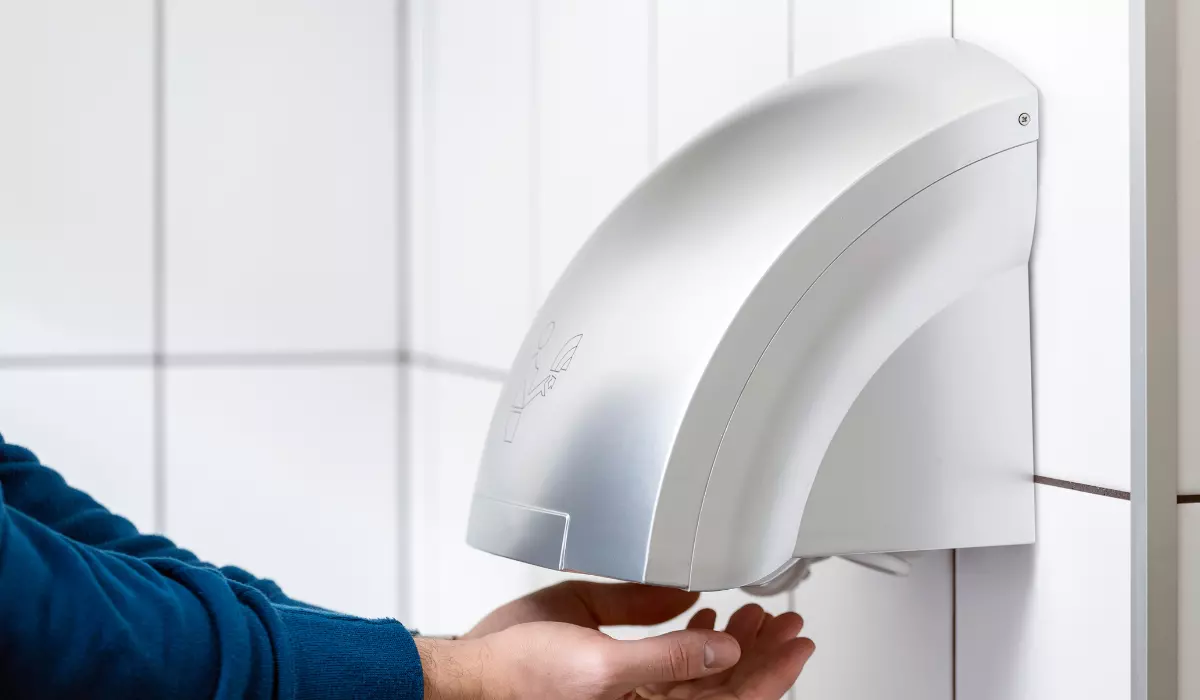
It might seem that hand drying is of little importance from a health and safety perspective. After all, washing hands thoroughly is what matters most, right? As it turns out, not necessarily. Drying them inadequately or incorrectly can contribute to recontaminating the skin with dangerous microorganisms. This issue is particularly critical in places where we might subsequently touch food or drinks with our hands—in restaurants, clubs, and other hospitality venues.
How to dry hands safely in a public washroom?
Drying hands safely in a public washroom requires keeping a few fundamental rules in mind. Above all, it demands far more cautious behaviour than at home. Why? The main reason is, of course, that a domestic bathroom primarily harbours bacteria and viruses that are already present on our skin anyway. This practically eliminates the risk of infection with new microorganisms that could prove potentially pathogenic (excluding, naturally, those that are harmless only when confined, for instance, to the gut, without contact with other parts of the body).
A public washroom is used by many people who carry a variety of bacteria and viruses. Infection most commonly occurs when various surfaces and fixtures are touched in succession by individual users.
Safe hand drying, just like washing and sanitising, therefore requires eliminating contact with the same surfaces touched by others. In practice—wherever possible—one should exclusively use touch-free appliances such as hand dryers or towel dispensers. You should also steer clear of situations where you use towels handed to you by someone else.
Thorough hand drying is also fundamental to safety. You should avoid situations where you simply wipe them on your clothes or use a hand dryer for just a few seconds.
Hygienic hand drying in a club or restaurant
It is worth noting here just how important thorough, hygienic hand drying is. Although washing significantly reduces the number of microorganisms present on the skin, it does not eliminate them entirely. Soap is not an agent capable of sterilising surfaces.
Bacteria remaining on hands that have not been dried thoroughly are given optimal conditions for survival. A warm, damp environment also causes them to multiply rapidly, which, combined with touching various surfaces, facilitates the colonisation of other areas and transmission to subsequent individuals. This is confirmed by research showing that one of the areas in a washroom with the highest concentration of bacteria is precisely the wet and relatively warm area around the washbasin.
It has also been demonstrated that proper hand drying can reduce the number of bacteria transferred from hands to equipment, food, and other people’s skin by up to 99%. The findings of these studies were published at the University of Cambridge in 1997 and in 2001 in the journal British Journal of Anaesthesia.
This means that people who do not dry their hands thoroughly enough—or skip this step entirely—are making a significant mistake from a hygiene and safety perspective. Damp hands not only promote the transfer of bacteria from skin to objects, but also vice versa. One only needs to imagine leaving a washroom and touching a door handle with damp hands, only to then proceed to eat finger foods or dishes traditionally eaten with one’s hands, such as sushi or pizza.
Hand dryer or paper towel in a restaurant?
One of the most frequent dilemmas and topics of debate is which commercially available solution is the most hygienic: a touchless hand dryer or a paper dispenser?
In the case of disposable towels, a major advantage is not only the ability to dry the skin quickly and thoroughly, but also the additional mechanical removal of any remaining dirt and bacteria. Their proponents also highlight the versatility of such a solution—they can be used to wipe away certain stains, a fairly common issue faced by patrons of dining establishments.
However, for this to be a genuinely hygienic option, several conditions must be met. Above all, paper hand towel dispensers must be truly airtight to ensure that microorganisms cannot enter inside. It is also essential to maintain their cleanliness—not only on the outside, but also inside, where they are handled by staff replenishing the paper supply.
Using towel dispensers also carries a higher risk of clutter—scattered, wet, and dirty scraps of paper towels not only look unsightly, but can also serve as an additional breeding ground for bacteria. This means that staff must monitor their status and washroom tidiness much more frequently.
For paper dispensers to be truly hygienic, they should be completely touchless. Devices of this type feature dedicated mechanisms that dispense the right amount of paper while preventing uncontrolled pulling of excess towels. These dispensers promote tidiness and reduce waste generation.
Automatic hand dryers equipped with a motion sensor generate no waste. Their drawback, however, is noise, which may discourage some people from using them. Furthermore, the sound of the dryer may be audible in the dining area, disrupting the ambient atmosphere.
This can be prevented by installing one of the modern dryer models designed for relatively quiet operation. Units currently available on the market produce noise levels comparable to a normal conversation. This not only makes using them more comfortable, but also avoids disturbing other guests.
Opponents of hand dryers point out that a powerful blast of warm air causes bacteria to be “blown off” the hands and subsequently dispersed onto nearby surfaces. A solution to this problem can be found in modern hands-in hand dryers, in which air is not immediately blown back out, but first passes through HEPA filters. At the same time, they are completely touch-free, providing genuinely hygienic drying while simultaneously purifying the air.
However, the advantages of hand dryers do not mean that paper towel dispensers have no place in a restaurant or club washroom. On the contrary—it is worth offering guests a choice, as well as providing backup for cleaning up stains or handling other unforeseen mishaps.
Hand drying in times of pandemic: how to do it safely?
There are various methods for drying hands, some of which are considered more hygienic than others. Without dedicated research, it is difficult to determine definitively whether it is better to use a dryer or paper towels. However, adhering to a few basic principles ensures that the entire procedure remains as safe as possible under the given conditions.
It must also be emphasised that ensuring safe hand drying begins the moment you enter the washroom. Avoiding touching door handles, taps, or other fixtures with bare hands can help limit the volume of microorganisms that end up on your skin, which would subsequently need to be washed away. Disposable gloves can be used for this purpose, although a far more eco-friendly solution is wrapping your fingers or hands in tissue paper or a piece of toilet paper.
Naturally, hygienic drying is impossible without strictly observing the principles of hand washing and sanitisation. An appropriate washing time and thorough soap distribution are an absolute prerequisite. One must also remember to use warm water, which rinses away bacteria much more effectively and helps lather the soap.
If there is a choice between two hand drying methods, it is best to choose the one that does not require touching any fixtures. For instance, touchless wall-mounted hand dryers will always be a better option than a towel dispenser whose design may force you to touch the entire roll or a push button.
However, this is not always possible. In such situations, using hand sanitiser, as recommended in public spaces, becomes an absolute necessity. Here too, check whether the dispenser provided is touch-free. Otherwise, it is better to use your own hand rub or gel, a pocket-sized bottle of which is always worth keeping on hand.
Hand washing and sanitisation is a topic that captured public attention on an unprecedented scale during the COVID-19 pandemic. Only then did it become evident how challenging maintaining hygiene in public places can be. It proved to be an issue even in venues where hygiene is particularly paramount. Visiting a restaurant, bar, club, or café inherently involves consuming food and beverages. The inability to maintain top-tier hygiene standards can cause numerous serious illnesses—not only those transmitted between individuals, but also those resulting from transferring our own bacteria to places where they should not be. Both proper washing and hygienic hand drying effectively prevent this, making visits to such hospitality venues significantly safer and more enjoyable.